
Thursday, August 20, 2026
Johnson & Johnson publishes report on surgical intelligence
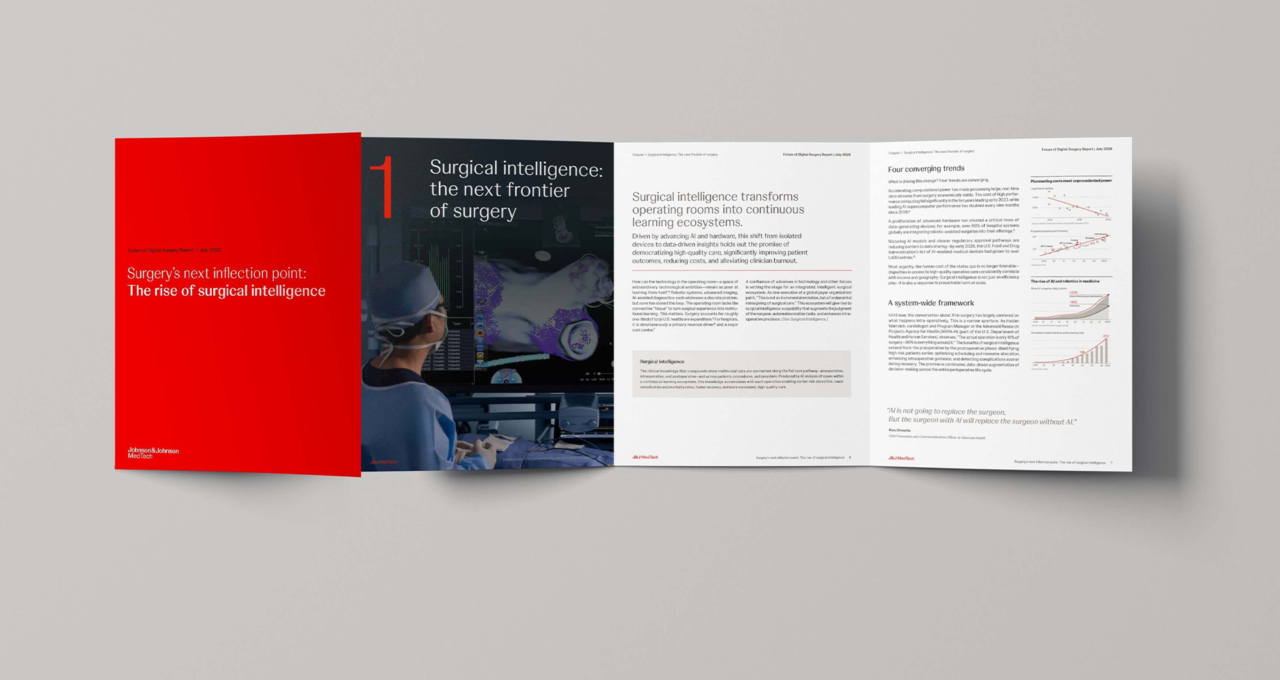
Johnson & Johnson has released a new Future of Digital Surgery report examining the emergence of surgical intelligence. The report, titled Surgery’s Next Inflection Point: The Rise of Surgical Intelligence, sets out how connected data, artificial intelligence and intelligent systems could influence the next phase of surgery.
Announced in New Brunswick on August 18, 2026, the publication aims to provide a common framework for a field that is still taking shape. Johnson & Johnson says the framework is intended to help healthcare stakeholders define, implement and scale surgical intelligence responsibly.
Operating room data in focus
The report points to the modern operating room as a data-rich environment, with information generated across multiple devices, applications and care settings. Much of that data remains separated across systems and institutions, limiting its value beyond individual procedures.
Johnson & Johnson links this challenge to broader pressures on healthcare systems, including workforce shortages, rising procedural complexity and financial constraints. The company argues that AI, connected technologies and advanced computing could help turn surgical data into clinical insight that improves over time.
A definition across the perioperative pathway
In the report, surgical intelligence is described as clinical knowledge created by connecting and analyzing multimodal data across the perioperative pathway. This includes preoperative planning, intraoperative execution and postoperative recovery.
The goal is to generate insights that support clinical decision making and improve operational performance. The report also stresses that the path forward is not only technical. It identifies governance, interoperability, sustainable economics and clinician-centered adoption as essential conditions for scale.
Input from healthcare and technology leaders
According to Johnson & Johnson, the report is based on interviews with more than 40 senior leaders from the surgical ecosystem. Participants included clinicians, providers, technology leaders, policymakers, investors and payers. The authors also reviewed more than 100 academic, clinical and industry publications.
Shan Jegatheeswaran, President of Polyphonic, MedTech, Johnson & Johnson, framed the topic as an ecosystem challenge. He emphasized that the future of surgery will depend not only on technological progress, but also on the ability to connect data, insights and people across care environments.
Call for coordinated action
The report calls on healthcare providers, clinical communities, industry and government to work together on the foundations needed for responsible innovation. Johnson & Johnson argues that decisions being made now on data sharing, governance, economics and adoption will influence how widely the benefits of surgical intelligence can be accessed.
For medtech and healthcare organizations, the publication adds to the growing debate over how digital surgery will move from isolated tools toward more integrated, data-driven systems.
Related articles

AbbVie teams up with Valkai on AI for clinical development
AbbVie is partnering with Valkai to apply AI in targeted clinical development areas and support faster insight generation.

Thieme plans to acquire Relias Learning
Thieme plans to acquire Relias Learning from Bertelsmann and expand digital education, compliance and training management for care providers.

HAL Allergy and InfectoPharm partner on ENT DiGAs
HAL Allergy and InfectoPharm have formed a multi-year DiGA partnership. The first focus is Meine Tinnitus App for ENT practices in Germany.

SBK calls for digital appointment management in healthcare
A YouGov survey for SBK highlights demand for digital appointment access. The insurer has integrated 116117 into its app.

Ads in ChatGPT: What pharma marketers need to know
OpenAI plans ads in ChatGPT. Pharma marketers may gain new HCP and awareness options, but privacy and policy limits are central.

From Anonymous Clicks to Connected HCP Journeys: Why Integrated SSO Matters in Pharma Marketing

German Red Cross blood donation services present digital donor service 2.0
The German Red Cross blood donation services have introduced donor service 2.0, a digital tool designed to support blood donors.

Johnson & Johnson launches MONARCH platform in the Middle East
Johnson & Johnson reports the first Middle East use of its MONARCH platform for robotically assisted bronchoscopy at Cleveland Clinic Abu Dhabi.